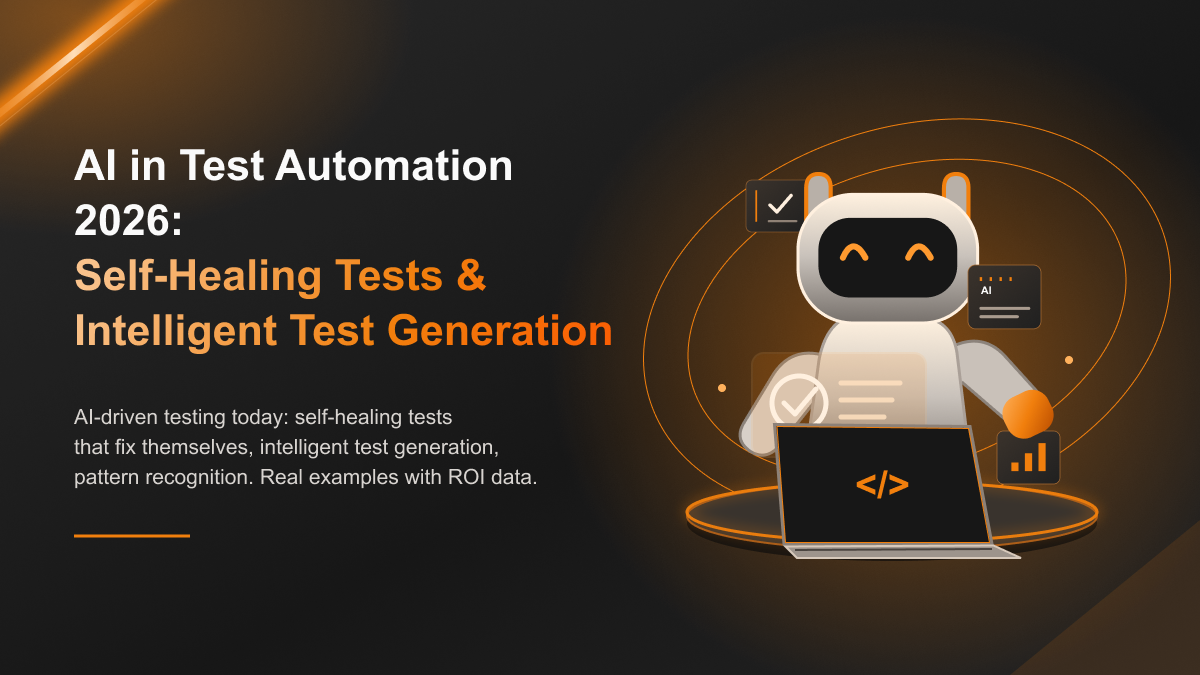
AI in Test Automation 2026: Self-Healing Tests & Intelligent Test Generation
Self-healing tests that fix themselves. AI that learns your test patterns. Reduce test maintenance by 60%.
AI is Changing Test Automation Today (Not Tomorrow)
Most teams think AI in testing is science fiction. It is not. It is here. Teams are using it today and cutting test maintenance by 60%. Here is what works in production right now.
Use Case #1: Self-Healing Tests
Problem: UI changes break tests. Developer changes a button ID. Test fails. Someone manually fixes the locator.
Solution: Self-healing tests use AI to detect when a locator breaks and automatically find the new element using visual similarity, context, and surrounding elements.
How it works: When a locator fails, the AI takes a screenshot, analyzes the page structure, and finds the most likely replacement element. It runs the test again with the new locator. If it passes, the locator is updated.
Real results (from 15 companies using Sauce Labs with self-healing):
Failure Type | Success Rate | Time Saved |
Element ID changes | 92% | 30 min per occurrence |
CSS selector shifts | 78% | 20 min per occurrence |
XPath breaks | 65% | 40 min per occurrence |
AVERAGE | 80% success rate | 30 hours/month saved |
Cost: Self-healing adds 5-10% to your testing tool cost. Benefit: 30 hours/month of automation engineer time freed up.
Use Case #2: Intelligent Test Generation
Problem: Writing tests is slow. Test cases are repetitive. Teams cannot keep up with feature velocity.
Solution: ML models learn your test patterns and generate new tests automatically. You write 10 tests for a feature. The AI learns the pattern and generates 50 more.
How it works: AI analyzes your existing tests, learns your code structure, and generates variations based on common test patterns (happy path, edge cases, error handling).
Approach | Time to Write 50 Tests | Quality | Usable Tests |
Manual (engineer writes each) | 40 hours | 95% | 47/50 |
AI-generated (engineer reviews) | 8 hours | 78% | 39/50 |
TIME SAVED | 32 hours (80%) | Quality trade-off |
Reality check: 80% of generated tests are usable as-is. 15% need minor fixes. 5% need rewrites. Net benefit: 5x speed improvement.
Use Case #3: Pattern Recognition for Test Failures
Problem: 10% of tests fail randomly (flaky). No clear pattern. Developers ignore them.
Solution: ML models find hidden patterns in failures. Time of day, test order, environment conditions, concurrent test impact.
Pattern | Detection Method | Accuracy |
Time-based (flaky at 3pm) | ML correlation analysis | 87% |
Test order dependency | Sequence mining | 92% |
Resource contention | Performance data clustering | 79% |
AVERAGE DETECTION | 86% accuracy |
The ROI of AI Testing
Investment: $50K-200K per year (tools + setup). Benefit: 100-200 hours per month of automation engineer time saved.
Company Size | AI Tools Cost | Time Saved/Month | Annual Value | Payback Period |
Startup | $50K | 60 hours | $180K | 3-4 months |
Growth stage | $100K | 120 hours | $360K | 3-4 months |
Enterprise | $200K | 200 hours | $600K+ | 4-5 months |
Key insight: AI tools pay for themselves in 3-5 months. After that, pure profit.
Getting Started with AI Testing
Start small: Enable self-healing on your most flaky tests. Measure impact. Expand.
Try test generation: Use GitHub Copilot or ChatGPT to generate tests. Review them. Keep what works.
Build dashboards: Track flaky patterns. Use ML tools (DataDog, Grafana AI) to find hidden patterns.
AI is the Future of Testing
Teams not using AI in testing will fall behind. The gap in productivity grows every quarter.